HVAC Design · 7 min read
HVAC-Related Condensation: When You Can Blame the HVAC Contractor — and When You Can’t
Sweating ductwork does not automatically prove an HVAC failure. Responsibility depends on the dew point, surface temperature, building boundaries, and who controls the air around the system.
The first reaction is almost always the same.
We get called into homes all the time for HVAC-related condensation, especially condensation occurring on equipment and ductwork installed in attics.
And the first reaction is almost always the same: The HVAC contractor screwed up.
Now, I’m not saying HVAC contractors aren’t stupid. We all know plenty of them are. This industry gives us more than enough examples every day.
But you cannot automatically blame the HVAC contractor every time an HVAC system sweats.
Sometimes the system is failing. Sometimes the environment you put the system in is the failure.
There is a very important difference.
The vented attic problem
When HVAC equipment and ductwork are installed in a vented attic in a hot, humid climate, that attic is essentially outdoors.
Southeast Louisiana. South Florida. The Gulf Coast. Pick your poison.
Outdoor dew points here are routinely brutal.
And a vented attic can sometimes experience moisture conditions even worse than the outdoor environment because moisture generated inside the house can migrate upward, adding to the moisture already entering from outside.
Now think about what we do next.
We install one of the most critical and moisture-sensitive systems in the entire house inside that environment.
We take ductwork carrying air somewhere around 50 to 55 degrees, wrap it in marginal insulation, connect it together with dozens or hundreds of seams, fittings, collars, plenums, boots, flex connections, access panels, refrigerant penetrations, and drain assemblies, and stick the whole thing in a hot, high-dew-point attic.
Then everybody acts surprised when it sweats.
Bam. Condensation.
That is not necessarily an HVAC equipment failure. That is physics.
You cannot blame the system for making cold air
An air-conditioning system is supposed to remove heat from the house.
That means portions of the equipment and distribution system are going to be cold.
You cannot blame the AC system because the air coming out of it is cold.
And you cannot automatically blame the HVAC contractor because the equipment he installed is actually doing what it was designed to do.
If the system is operating reasonably, producing the proper temperature drop, moving the right amount of air, removing moisture from the conditioned space, and otherwise performing as intended, but the exterior surfaces of the equipment and ductwork are below the dew point of the attic air surrounding them, you have an environmental problem.
Not necessarily an equipment problem.
The system did not create that attic environment. It is simply reacting to it.
“We’ve always done it this way”
This is where the famous construction industry excuse comes into play: “We’ve always done it this way.”
Exactly. And we have always had problems.
Putting HVAC systems in vented attics has been common practice for decades. Common does not mean correct.
If you install cold HVAC equipment and ductwork in a vented attic in a hot-humid climate, condensation should not shock anyone. I would argue you should expect it.
Physics always wins.
And when water shows up, you better start paying attention.
Because where you have persistent water, you dramatically increase the potential for microbial growth, material deterioration, corrosion, insulation damage, and eventually major building failure.
We put the most important system in the worst place
Think about how ridiculous this really is.
The HVAC system is arguably the most important mechanical system in the house.
It plays a major role in moisture control, dehumidification, ventilation, filtration, pressure relationships, air distribution, indoor air quality, comfort, and durability.
It influences nearly everything associated with the indoor environment.
Yet we routinely install this sophisticated, moisture-sensitive equipment in the most hostile environment available.
The attic.
Then, when it fails, we blame the guy who installed it exactly where the house was designed for him to install it.
That does not always make sense.
So what do you do in an existing home?
In a retrofit situation where the HVAC equipment is in a vented attic and condensation is occurring, the first question should be: Is the HVAC system actually malfunctioning?
If the answer is no, and the condensation is occurring because surface temperatures are falling below the surrounding attic dew point, you basically have two choices.
Bring the HVAC system into the house. Or bring the house into the attic.
Moving an entire HVAC system and duct distribution network into conditioned space can be extremely intrusive and expensive in an existing home.
In many retrofit applications, the more practical solution is to move the building enclosure.
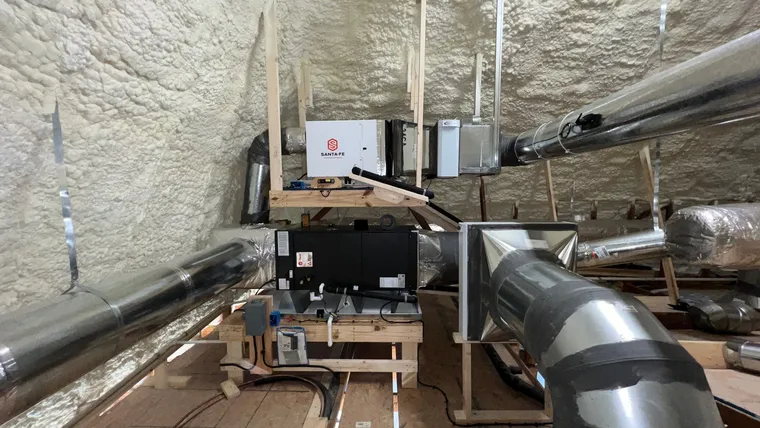
Encapsulate the attic. Move the primary air and thermal boundary from the ceiling plane to the roofline.
Now the HVAC system is no longer sitting outside.
The attic becomes part of the building enclosure, and the moisture conditions surrounding the equipment can actually be controlled.
But this is where the responsibility changes.
The encapsulated attic changes everything
Once the attic is encapsulated, whether through spray foam, a properly designed double-roof assembly, or another method of moving the primary air and thermal boundary to the roofline, the attic is no longer functionally outside.
The HVAC system is now inside the building enclosure. The attic air is part of the indoor environment.
And now I absolutely will blame the HVAC contractor.
Why?
Because the HVAC contractor’s responsibility is to gain control of the air mass inside the house and maintain that control.
And his number-one priority in a hot-humid climate should be moisture control.
If the HVAC contractor installs equipment in an encapsulated attic and allows attic dew points to remain high enough that the equipment, ductwork, registers, plenums, or other cold surfaces repeatedly condense, that is no longer simply an unfortunate interaction between cold equipment and outdoor conditions.
That is a failure to control the indoor air mass.
The attic is now part of the house. It is inside the pressure boundary. It is inside the thermal boundary. Its moisture conditions must be controlled.
If they are not, somebody failed to properly design, install, commission, or operate the mechanical system responsible for controlling that environment.
And yes, in that situation, the HVAC contractor deserves a whole lot more scrutiny.
The difference is responsibility for the air
This is really what the entire argument comes down to.
In a vented attic, the HVAC contractor does not control the attic air. The attic is outside the building enclosure.
If the HVAC system is performing properly but sweating because it is surrounded by extremely humid air with a high dew point, blaming the HVAC contractor simply because the ductwork is cold misses the larger problem.
The building put the HVAC system in a hostile environment.
In an encapsulated attic, the situation is completely different.
That attic is now part of the controlled environment. The mechanical system has responsibility for that air.
And if that air is not being adequately dehumidified and controlled, the HVAC design has failed one of its most fundamental responsibilities.
Stop diagnosing condensation by looking at the water
Condensation is not the diagnosis. Condensation is the symptom.
You have to determine why the surface temperature crossed the dew point.
Was the duct insulation damaged? Is there excessive air leakage? Is the system producing abnormally low supply-air temperatures? Is airflow restricted?
Is the attic vented and sitting at an 85-degree dew point? Was the attic encapsulated without any strategy whatsoever for controlling its moisture?
Is outdoor air infiltrating? Is the building under negative pressure? Is the dehumidification strategy inadequate?
Those answers determine responsibility. Not the puddle of water on the attic floor.
The HVAC contractor is not automatically innocent. And he is not automatically guilty.
Understand where the air and thermal boundaries are. Understand who controls the air surrounding the HVAC system. Understand the dew point. Understand the surface temperature.
Then blame the right problem.
Because whether anyone wants to admit it or not, condensation still follows physics.
And physics does not care who sent the invoice.
Need answers about your home?
ACC Building Performance is local to the Gulf South and serves the entire United States, finding and documenting the root cause of moisture, mold, HVAC, and indoor air quality problems.
Book Your Assessment