Building Science · 5 min read
You Need a Comprehensive Solution to a Complex Set of Problems
Moisture, HVAC, pressure, and indoor air problems interact. A lasting fix takes one coordinated plan from diagnosis through construction and commissioning.
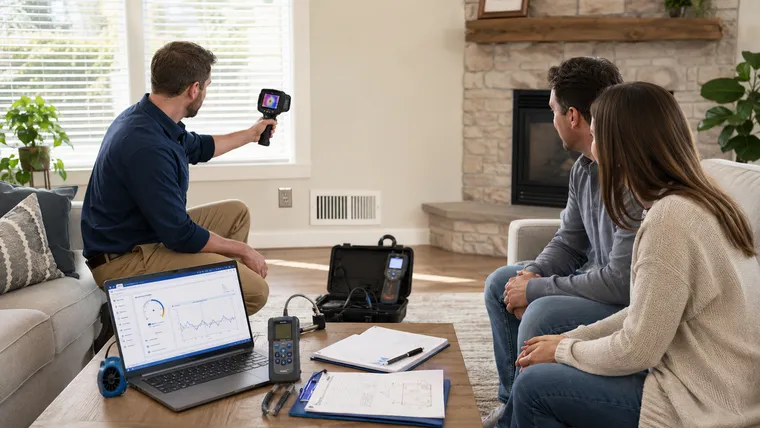
You do not have a simple problem.
If you are dealing with moisture, suspected mold, indoor air quality concerns, HVAC problems, condensation, enclosure failures, pressure issues, or health symptoms connected to your home, you are probably dealing with a complex set of problems that are all interacting with each other.
And this is where the industry falls apart.
The HVAC guy should be cutting grass. The roofer looks at the roof. The insulation guy should be weed-eating with the HVAC guy. The mold guy should go back to selling cars. The builder, well, he’s an idiot... The IAQ guy takes an air sample.
Everybody has their piece, or so they think. Almost nobody brings the whole damn thing together.
But a house is a system.
The attic affects the house. The crawlspace affects the house. The HVAC affects the enclosure. Pressure affects airflow. Airflow affects moisture. Moisture affects microbial growth. Duct leakage affects everything.
And all of it affects the environment you and your family are breathing every day.
That is why fixing one problem in isolation often does not solve anything. Sometimes it simply moves the problem somewhere else or creates a new one.
I know this from both sides.
I am a building science practitioner, licensed General Contractor, and Mechanical Contractor specializing in healthy, high-performance construction, with a specific focus on building enclosures and mechanical systems.
But I have also been the homeowner on the other side of this.
I suffered severe health issues from living in a poorly performing home. I know what it feels like to be sick, lost, and looking for answers while different professionals give you different opinions and nobody seems capable of putting the entire picture together.
That experience changed the direction of my career.
People dealing with these homes do not need another person pointing out problems and leaving them with a report and one question: “Now what?”
The real questions are: Why is this happening? What caused it? What else is it affecting? What has to change? What order does the work need to happen in? And what happens if somebody screws it up?
The building has to be treated as a complete system.
That is where building science matters.
You cannot replace HVAC without understanding the enclosure. You cannot encapsulate an attic without understanding moisture, pressure, ventilation, and combustion safety. You cannot seal a house without understanding ventilation. You cannot remediate microbial growth and leave the moisture source behind. You cannot install a large exhaust system and ignore makeup air.
These things are connected.
That is why I look at the building as a complete system: enclosure, mechanical systems, ductwork, moisture, pressure, airflow, ventilation, filtration, exhaust, combustion, attics, crawlspaces, and the air communication between all of them.
Then I develop the solution. Not just a list of problems. A solution.
I develop the scope of work. I design the mechanical systems when necessary. I determine the sequence of construction. I coordinate the moving pieces. And when it makes sense, I execute the work myself.
That is what makes what I do different. I am not just diagnosing the failure. I can carry the solution all the way through.
The recommendations have to stand on their own.
Of course, someone may ask, “Isn’t that a conflict of interest? You identify the problems and then potentially get paid to fix them.”
My answer is transparency.
I am very clear about what I do. I am a building science practitioner, General Contractor, and Mechanical Contractor. Part of the value I bring is having the ability to diagnose the problem, design the solution, and execute it correctly.
My recommendations still have to stand on their own. They have to be supported by the conditions in the building, physics, building science, accepted construction practices, and sound mechanical design.
And nobody is obligated to hire me to perform the work. Take my scope. Get another opinion. Send it to another qualified contractor. Price it somewhere else. Good luck, but I have no problem with that.
My concern is that the work gets done correctly.
There is a huge difference between creating unnecessary work for yourself and being qualified to carry a legitimate solution from diagnosis through completion.
Execution is where projects succeed or fail.
In fact, one of the biggest problems I see is the opposite.
It is easy to write: “Seal the enclosure.” “Replace the HVAC.” “Encapsulate the attic.” “Install a dehumidifier.” “Remediate the microbial growth.”
But how? What happens first? What gets removed? What gets cleaned? What gets sealed? Where are the pressure and thermal boundaries? How does the HVAC change? How does the dehumidifier integrate? How do you keep one trade from destroying what another trade just completed? How is everything commissioned when the work is finished?
Those details are where projects succeed or fail. And that is why execution matters.
You should not have to manage this alone.
Many of my clients need a turnkey solution.
If you are already sick, overwhelmed, and trying to figure out whether your home is contributing to your health problems, the last thing you need is to become a building scientist, mechanical designer, contractor, moisture expert, and project manager just to get your house fixed.
You should not have to suffer through that part of the process too.
My goal is to take that burden off of you. Understand the problem. Bring the disciplines together. Develop the right solution. And execute it at the highest level possible.
Because I know the implications of doing it wrong.
You do not need another person telling you your house has problems. You need someone who can bring it all together.
You need a comprehensive solution to a complex set of problems.
That is what I do.
Need answers about your home?
ACC Building Performance is local to the Gulf South and serves the entire United States, finding and documenting the root cause of moisture, mold, HVAC, and indoor air quality problems.
Book Your Assessment